Business and Economics Competitions 2027: Deadlines and Calendar for High School Students
Hinksey Labs
25 min read

Interested in economics, entrepreneurship, finance or business strategy? Competitions are a great way to explore these subjects beyond the classroom, whether you're writing an analytical essay, pitching a startup or solving an economic problem.
But business and economics competition deadlines for 2027 vary significantly. Some competitions are already accepting entries, while others have yet to announce their next cycle - and a few are open only to schools in one country or to members of a student organisation.
This guide covers 19 competitions for high school students, including deadlines, eligibility (including whether students outside the US can enter), what each involves and, where the organiser publishes one, its rule on AI. Most focus on business or economics; two well-known open-topic essay contests are included too, because some of their prompts touch on economic questions.
Business and Economics Competitions 2027: Deadline Calendar
| Competition | Key dates | Format | Students outside the US? |
|---|---|---|---|
| John Locke Institute Global Essay Prize | 2027 TBA (2026: register by 31 Mar, essay by 31 May) | Individual essay, up to 2,000 words | Yes |
| Hinksey Labs Business Essay Competition | 2027 TBA (2026: essay by 14 Oct) | Individual case-study essay, 1,000-1,500 words | Yes |
| Harvard International Economics Essay Contest | Essay by 5 Jan 2027 | Individual essay, up to 1,500 words | Yes |
| Conrad Challenge | Activation Stage closed 29 Oct 2026; Innovation Stage by 7 Jan 2027; summit 21-24 Apr | Team innovation brief, video and website, then pitch | Yes |
| Diamond Challenge | Concept by 14 Jan 2027 | Team venture concept, then pitch | Yes |
| National High School Fed Challenge | Register by 15 Feb 2027; script by 15 Mar 2027 | Team podcast script, 1,500-2,500 words | No (US schools and DoWEA schools only) |
| Blue Ocean Student Entrepreneur Competition | Pitch by 21 Feb 2027 | Video pitch, solo or team | Yes |
| Harvard Crimson Global Essay Competition | Register by 10 Feb 2027; essay by 23 Feb; finalists by 19 Mar | Individual essay, 400-500 words, then 1,000-1,500 for finalists | Yes |
| USA Economics and Business Olympiad | Register by 27 Feb 2027; rounds 13 and 27 Mar | Individual online exams | Yes (Team USA selection is restricted) |
| FBLA Virtual Business Challenge | Round 2: 1-26 Feb 2027; final: 29 Mar-2 Apr | Team online business simulation | FBLA members only |
| Minds Underground Economics Essay Competition | Questions from 26 Nov 2026; essay by 3 Apr 2027 | Individual essay, 1,000-1,500 words | Yes |
| DECA Competitive Events | ICDC: 17-20 Apr 2027 | Role-plays, prepared events, simulations | Yes, via DECA associations (some outside the US) |
| Wharton Global High School Investment Competition | Registration closed; final report by 4 Dec 2026; finale 29-30 Apr 2027 | Team investment simulation and reports | Yes |
| National Economics Challenge | 2027 TBA; state dates vary | Team economics tests | No (US state competitions) |
| MAS-ESS Essay Competition | 2027 TBA (2026: essay by 1 May) | Essay up to 2,000 words plus 300-word summary | Only students in Singapore, and Singaporeans abroad |
| Cambridge Re:think Essay Competition | 2027 TBA (2026: essay by 10 May) | Individual essay, up to 2,000 words | Yes |
| Harvard Crimson Business Competition | 2027 TBA (2026: preliminary by 1 Jun; final 25-28 Jun) | Slide presentation, solo or team, then in-person final | Not stated (final is in person at Harvard) |
| RES Young Economist of the Year | 2027 TBA (2026: entry by 29 Jun) | Blog up to 1,000 words, or a video, podcast or slides | Only students studying in the UK |
| Marshall Society Essay Competition | 2027 TBA (2026: essay by 30 Aug) | Individual essay, up to 1,500 words | Yes |
Some of these competitions belong to the 2026-27 academic year and have already closed registration; they are included so you can plan for the next cycle. Dates, fees and rules can change, so confirm the current details on the organiser's own page before you enter.
19 Business, Economics and Essay Competitions to Explore
1. John Locke Essay Competition 2027: The Global Essay Prize
Best for: economics, independent research and argumentative writing.
The John Locke Institute Global Essay Prize invites students to write original, evidence-based arguments in ten subjects: Economics, History, International Relations, Law, Philosophy, Politics, Psychology, Public Policy, Science & Technology and Theology. The Institute says it receives tens of thousands of submissions from students in more than 150 countries.
The 2026 Economics questions were "Should we fear a cashless society?", "Technology now allows personalised pricing. If this came to be widely used, what effects should we expect?" and "Did Jeff Bezos get rich at the expense of his customers, his employees, neither or both?" - each asks you to weigh an economic trade-off rather than describe a topic.
- Format: an individual essay of up to 2,000 words answering one official question, in English. In-text citations count towards the limit; diagrams, data tables, endnotes and the bibliography do not. A teacher or other non-relative adult acts as referee.
- Eligibility: in 2026, open to students in any country who were under 19 on 31 May 2026. Students under 15 compete in a separate Junior category. Standard entry is free.
- Judging: essays are judged on "knowledge and understanding of the relevant material, the competent use of evidence, quality of argumentation, originality, structure, writing style and persuasive force". Some contestants may be invited to an online interview about their essay.
- AI use: the Institute allows large language models for research support and as a thought partner, but not as a substitute for the author, and judges any use case by case. Its FAQ advises that "your safest course of action is simply not to use it at all."
- 2027 deadline: TBA. In 2026, registration ran from 2 February to 31 March (late registration, for a fee, until 30 April), essays were due by 31 May, paid late-entry extensions ran to 7 or 21 June, and the shortlist was notified on 7 July.
Deadlines quoted for John Locke vary from site to site, so work from the official timeline: in 2026 the regular essay deadline was 31 May, not April. Prizes are scholarships towards John Locke Institute programmes in each category and age group, plus an overall prize for the best essay. Check the official website for the 2027 questions and rules once they are released. For a closer look at preparing an entry, see our John Locke Essay Competition guide.
2. Hinksey Labs Business Essay Competition
Best for: business strategy, research and case-study analysis.
The Hinksey Labs Business Essay Competition challenges students to investigate how a major change affects a real company or non-profit. The 2026 theme, Shifts That Change the Game, asked entrants to pick an organisation affected by a change such as the rise of AI, environmental pressures, market shifts or a change in leadership.
- Format: an individual 1,000-1,500-word case-study essay covering the organisation's background, the shift, its impact and the organisation's response, with APA references. One entry per person, in English.
- Eligibility: high school students aged 14-18 worldwide. Entry was free in 2026.
- Judging: scored by the Hinksey Labs team of Ivy League and Oxbridge academics on four criteria - evidence and sources, insight and originality, clarity and structure, and use of business concepts.
- Prizes: in 2026 the top three won scholarships of 100%, 75% and 50% to any Hinksey Labs programme (subject to admission requirements), the top 10 finalists received an official certificate of achievement, and every entrant got priority interview consideration for the next Hinksey Labs cohort.
- AI use: AI tools may support your research and writing, but the entry must reflect your own thinking and analysis; plagiarism or over-reliance on AI-generated content means disqualification.
- 2027 deadline: not yet announced. The 2026 competition closed on 14 October 2026 and winners were announced on 21 October.
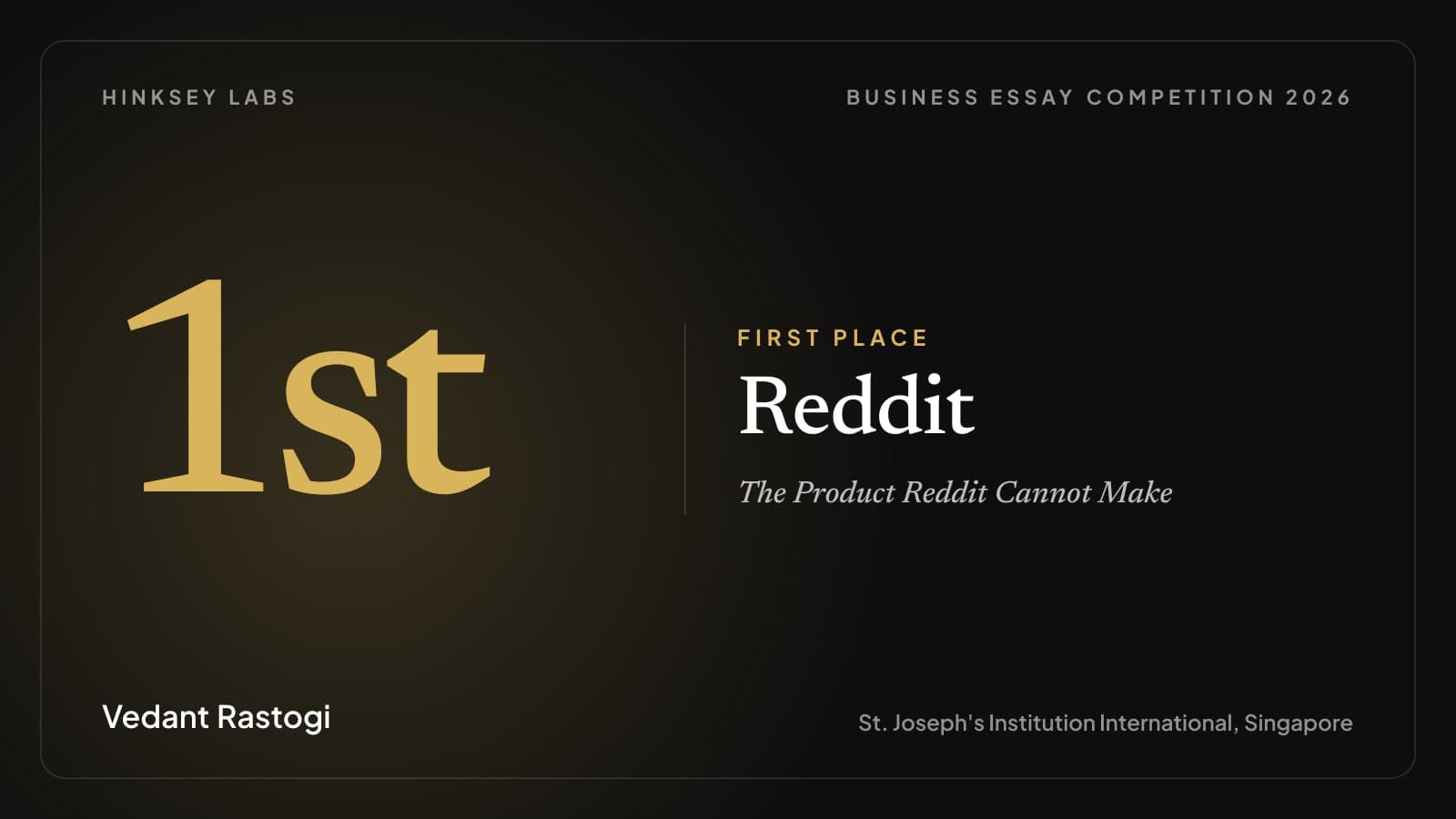
The 2026 winning essays show what strong business analysis looks like at this level: The Product Reddit Cannot Make (first place), Haaland Hates Cruises (second) and Centrus Energy: Winner and Casualty of America's Russian Uranium Ban (third).
3. Harvard International Economics Essay Contest
Best for: economic policy and analytical writing.
The Harvard International Economics Essay Contest, run by the student-led Harvard Undergraduate Economics Association, asks students to analyse a contemporary economic question. The 2026-27 prompts cover AI and young people's first jobs, caps on international students, whether everyday payment systems should be free to use, who should pay for damage to homes in the most dangerous places, and minimum wages where much work is informal - or you can pose and answer your own economics question.
- Format: an individual essay of up to 1,500 words, including footnotes but excluding references, submitted as an anonymous PDF.
- Eligibility: high school students anywhere in the world, including homeschooled students, in separate Grade 9-10 and Grade 11-12 divisions. There is an entry fee; students who cannot pay can email the organisers about a waiver.
- Judging: judges read each essay anonymously and score analysis, creativity, research and structure; the strongest essays go to a final panel.
- AI use: AI tools are allowed, but the ideas and arguments must be your own and every source must be cited. The organisers say they never use AI to score essays.
- Deadline: 5 January 2027, 11:59 p.m. Eastern Time. Late entries are not accepted.
4. Conrad Challenge
Best for: innovation, entrepreneurship and business planning.
The Conrad Challenge, a global student innovation competition whose finals are held at Space Center Houston, asks teams to design an innovation that solves an important problem and propose a workable business plan for it. The 2026-27 categories are Aerospace and Aviation, Cyber-Technology and Security, Energy and Environment, Health and Nutrition, and the Water Challenge.
- Format: three stages. In the Activation Stage, teams register and submit a Lean Canvas for their idea. Teams cleared to continue then submit an Innovation Brief (ten questions covering the innovation, its impact, progress, market and business model), a 3-5 minute Innovation Video and a team website. Finalists give pitches at the Innovation Summit (2026-27 student guide).
- Eligibility: students aged 13-18 on teams of two to five, who can come from different schools or countries, with a coach aged at least 18 (a teacher, parent, subject-matter expert or other qualified mentor). Teams may compete from anywhere in the world.
- Judging: entrepreneurs, business people, educators, scientists, engineers and investors score submissions against a scoring guide and give each team coaching comments; finalists are announced in February 2027.
- Dates: the 2026-27 Activation Stage (registration and Lean Canvas) closed on 29 October 2026. Teams cleared to continue submit their Innovation Stage materials by 7 January 2027, 11:59 p.m. Central Time, and the Innovation Summit runs 21-24 April 2027 in Houston.
Thinking of entering with a team? Our Conrad Challenge guide covers the competition in more depth.
5. Diamond Challenge
Best for: entrepreneurship and startup development.
The Diamond Challenge, an initiative of Horn Entrepreneurship at the University of Delaware, invites teams to develop an original venture in one of two tracks: Business Innovation or Social Innovation.
- Format: teams submit a 3-5 page written concept narrative and a 60-second introductory video. Teams that reach the minimum score advance to a pitching round (a five-minute pitch and three minutes of questions), and finalists go on to the in-person Limitless World Summit on 29-30 April.
- Eligibility: teams of 2-4 high school students aged 14-18, from any country, with an adult advisor aged 21 or over. Each student can join one team and submit one concept per year.
- Dates: advancing teams are notified on 10 February and finalists announced on 9 March.
- Deadline: 14 January 2027, 5 p.m. Eastern Time.
6. National High School Fed Challenge
Best for: macroeconomics and economic research, for students at US schools.
The National High School Fed Challenge, run through the US Federal Reserve System with entries evaluated by the Federal Reserve Bank of New York, sets one theme a year. The 2026-27 theme is Economics of Housing, and this year's entry is an informative economics podcast script rather than a paper.
- Format: one podcast script per school team, 1,500-2,500 words excluding citations, on a topic that relates explicitly to the theme (2026-27 rule book).
- Eligibility: teams of three to eight students in Grades 9-12, one team per school, with a faculty advisor certified by the principal. Schools must be in one of the 12 Federal Reserve Districts or a US territory, or be an overseas Department of War Education Activity (DoWEA) school - so most international schools cannot enter.
- AI use: an entry written in whole or in part by AI is not considered original student work, and entries with AI-generated content may be disqualified.
- Recognition: all entering teams are recognised in the Journal of Future Economists, and Federal Reserve staff select scripts to publish in it.
- Deadlines: registration closes 15 February 2027; scripts are due 15 March 2027.
7. Blue Ocean Student Entrepreneur Competition
Best for: business innovation and pitching.
The Blue Ocean Student Entrepreneur Competition challenges students to develop business ideas that create new market space rather than compete head-on with existing businesses.
- Format: a recorded video pitch of under five minutes, solo or in a team of up to five, structured with the Blue Ocean pitch template.
- Eligibility: high school or equivalent pre-university students anywhere in the world (IB, A-level, IGCSE and other curricula included), plus homeschooled students aged 14-18. Entry is free.
- Judging: several judges score each pitch on five equally weighted criteria - Blue Ocean creativity and value innovation, impact and market potential, technical feasibility, commercial viability and scalability, and quality of presentation and use of Blue Ocean tools (rules and FAQ).
- AI use: allowed and need not be declared, but the core business idea and reasoning must be your own.
- Deadline: 21 February 2027, midnight in your local time zone.
8. Harvard Crimson Global Essay Competition
Best for: open-topic argumentative, creative and journalistic writing.
The Harvard Crimson Global Essay Competition (HCGEC) is a virtual writing contest whose organising partners are The Harvard Crimson and Crimson Education. Entrants pick one prompt in one of three tracks - creative, argumentative or journalistic - and the prompts are not economics questions, though some reach into business: a 2026 journalistic prompt asked how young people have reshaped an industry (2026 prompts). The 2027 prompts are due by 30 January 2027.
- Format: a regional-round essay of 400-500 words, with titles and citations not counted; entries are compared within one of five world regions, and regional finalists expand their essay to 1,000-1,500 words for the global round (terms and conditions).
- Eligibility: students aged 10-18 in any country who are at secondary or high school during February-March 2027, or who have graduated but will not start college before September 2027. One entry per person. There is a registration fee, which is lower in the early-bird period ending 15 December 2026.
- AI use: entries must be original work and are screened for plagiarism and AI use.
- Deadlines: registration closes 10 February 2027 and regional essays are due 23 February; regional winners are announced on 10 March, global-round essays are due 19 March and global winners are announced on 31 March 2027 (all 23:59 GMT).
9. USA Economics and Business Olympiad
Best for: economics knowledge and problem-solving.
The USA Economics and Business Olympiad (USAEBO) tests economic reasoning through two individual online rounds that can be taken from school, home or a library.
- Format: Round 1 is 40 multiple-choice problems; Round 2 is open free-response problems.
- Eligibility: open to students of any citizenship aged 20 or under on the first day of that year's international competition. Team USA selection is limited to US citizens, permanent residents and full-time students at US schools.
- Recognition: honour rolls in Round 1 and gold, silver, bronze and honourable mention in Round 2; five students are selected to represent the US at the International Economics Olympiad.
- Deadlines: registration closes 27 February 2027, 11:59 p.m. Eastern Time; Round 1 is on 13 March and Round 2 on 27 March 2027.
10. FBLA Virtual Business Challenge
Best for: business management and financial decision-making.
The FBLA Virtual Business Challenge, run for FBLA by Knowledge Matters, has teams apply business concepts in online simulations, in a Personal Finance track and a Management track.
- Format: online simulation rounds in which teams make budgeting, operations and business decisions.
- Eligibility: teams of one to three high school members of FBLA chapters with current dues.
- Recognition: the top 20 teams per round in each track qualify for the virtual final (no more than one team per state, per round, per track), and the top three teams in the final win cash prizes.
- Dates: Round 1 runs 13 October-6 November 2026; Round 2 runs 1-26 February 2027; the final takes place 29 March-2 April 2027.
11. Minds Underground Economics Essay Competition
Best for: economics essays on everyday puzzles, from pricing to currencies.
The Minds Underground Economics Essay Competition, run by Minds Underground in partnership with ASEEDER, is one of more than 20 subject competitions the organiser holds each year. Its 2026 questions were grouped under mathematical, behavioural, international and environmental economics, and ranged from "Why do people tip in restaurants they'll never return to?" to "Could a digital-only currency replace the US dollar as the world's reserve?"
- Format: an individual essay answering one question, 1,000-1,500 words for Senior entries, with Harvard referencing; in-text citations count towards the limit and the bibliography does not (competition guidelines).
- Eligibility: students in the UK and internationally. The Senior prizes are aimed at the penultimate year of school (Grade 11 in the US) but welcome younger entrants, and students aged 14 and under enter a separate Young Minds prize. There is an entry fee for each subject, waived for students eligible for the organiser's Access Scheme (2027 competitions).
- Judging: originality and depth of thought, clarity of expression, coherence and structure, evidence of wider reading, and awareness of real-world, ethical or interdisciplinary dimensions.
- AI use: AI tools may be used only for background research or exploring ideas; AI-generated phrasing, arguments or structure in the essay is not permitted and may lead to disqualification.
- Deadline: 3 April 2027 (UK time), with no extensions. The 2027 questions are released from 26 November 2026.
12. DECA Competitive Events
Best for: marketing, entrepreneurship and business operations.
DECA runs high school competitive events covering business operations research, marketing, entrepreneurship and finance, grouped into role-plays and case studies, prepared events, and online simulations.
- Format: depending on the event, a career-cluster exam with a role-play or case study in front of a judge, a prepared written project and presentation, or a business simulation; some events are individual and others are for teams of two or three.
- Eligibility: DECA members who qualify through their chartered association's conferences. Most associations are US states, but there are associations outside the 50 states as well - Ontario, Germany and Puerto Rico (chartered associations) - so ask your chapter advisor which events your association offers.
- Recognition: qualifiers compete at the International Career Development Conference (ICDC).
- Dates: ICDC takes place 17-20 April 2027 in Anaheim, California (ICDC dates). Prepared-event entries for ICDC are uploaded 23-30 March 2027.
If your school has a DECA chapter, our guide to DECA competitions looks at the events in more detail.
13. Wharton Global High School Investment Competition
Best for: investing, financial analysis and teamwork.
The Wharton Global High School Investment Competition has teams build a long-term investment strategy for a fictional client, set out in an annual case study, using the Wharton Investment Simulator.
- Format: teams manage a virtual portfolio and submit four deliverables - a team roster, a trading notes analysis, an investment policy statement and a final report. Judges pick 50 semifinalists, and the top 10 teams go to the Global Finale.
- Eligibility: teams of four to six students in Grades 9-12 with a teacher from their school as advisor; teams compete against schools from around the world. Entry is free.
- Judging: not portfolio performance, but the quality of the investment strategy and its fit with the client's objectives, the strength of the research and analysis, and how well the team communicates and defends its recommendations.
- AI use: Wharton Global Youth says it embraces generative AI as a tool, warns that its output can be inaccurate, and asks students to read its Statement of AI Use before submitting written work.
- Dates: registration for 2026-27 closed on 11 September 2026; final reports are due 4 December 2026, and the Global Finale is on 29-30 April 2027 in Philadelphia.
14. National Economics Challenge
Best for: microeconomics, macroeconomics and economic theory.
The National Economics Challenge, run by the Council for Economic Education, tests economic knowledge through state competitions, online national semifinals and national finals.
- Format: team rounds covering microeconomics, macroeconomics, international economics and current events; the 2026 online semifinal was a 45-question multiple-choice test, with each team scored on its top three individual results.
- Eligibility: teams of three or four students from the same school or organisation, entering through their US state's competition, in two divisions - David Ricardo, for first-time competitors who have taken no more than one economics course, and Adam Smith, for AP, IB and honours students and returning competitors (2026 rules).
- Recognition: winning state teams advance to the national semifinals, and the top teams go on to the national finals (held in Atlanta in May 2026).
- 2027 deadline: national dates TBA; state registration schedules vary.
15. MAS-ESS Essay Competition (Singapore)
Best for: economic policy writing, for students in Singapore.
The MAS-ESS Essay Competition is run by the Monetary Authority of Singapore with the Economic Society of Singapore and sets one question a year on Singapore's economic future. The 2026 topic was "Singapore's AI-Driven Economic Future: How can artificial intelligence reshape our industries, workforce, and competitive advantage while ensuring inclusive growth and managing disruption?"
- Format: a main essay of no more than 2,000 words (strictly enforced, excluding charts, tables, footnotes, references and appendices), a summary of up to 300 words and a bibliography, in English. Essays should be accessible to a general audience rather than written in academic journal style, and should avoid equations; joint entries are allowed (2026 terms and conditions).
- Eligibility: pre-university students studying in Singapore, of any nationality - including at international schools, junior colleges, polytechnics and centralised institutes - plus full-time national servicemen and Singaporean pre-university students studying abroad. Students at schools outside Singapore are not eligible unless they are Singaporean.
- Judging: a panel from the Economic Society of Singapore, the financial and private sectors and government agencies shortlists essays; the top four finalists present their essays, and the winners are decided on both the essay and the presentation.
- 2027 deadline: TBA. The 2026 competition opened on 9 March and closed on 1 May 2026.
16. Cambridge Re:think Essay Competition
Best for: debate-style essays on politics, ethics and public policy.
The Cambridge Re:think Essay Competition is run by the Cambridge Centre for International Research (CCIR). Its 2026 Senior prompts were broad debate questions rather than economics ones, though several had an economic edge - whether meritocracy is a fair system or "a myth that disguises structural inequality", whether open borders would destabilise societies and undermine welfare systems, and whether governments should fund speculative moonshot science or prioritise incremental improvements.
- Format: an individual essay of up to 2,000 words, excluding footnotes and bibliography, answering one prompt, with MLA citations.
- Eligibility: students aged 11-18 anywhere in the world who have not started undergraduate study, in a Junior Division (ages 11-13) and a Senior Division (ages 14-18). Entry is free.
- Judging: essays go through double-blind review by a panel of scholars, who look for original ideas and for the quality of argument and writing.
- AI use: "The use of AI tools for assistance in writing is strictly prohibited," and every submission is run through plagiarism and AI checks.
- 2027 deadline: TBA. In 2026 the competition opened on 15 January, essays were due by 10 May and results came out on 26 May, followed by an award ceremony at King's College, Cambridge, on 31 July.
17. Harvard Crimson Business Competition
Best for: entrepreneurship and presenting a product idea.
The Harvard Crimson Business Competition (HCBC), run by The Harvard Crimson and hosted alongside ASEEDER, asks students to design a company and product that tackle a global challenge. Students who qualify in the online preliminary round go on to a final round held in person at Harvard.
- Format: a preliminary submission of a 14-18-slide presentation covering the company's mission, the global challenge it addresses, the product and its features, the target market, how it will reach customers and its plans for growth (guidelines). Qualifiers attend the Global Championship Round, a multi-day conference in Cambridge, Massachusetts, where teams receive a new prompt and present on the final day.
- Eligibility: individuals or teams of up to four, in a Senior Division for Grades 9-12 (a Junior Division covers Grades 6-8). The site does not say which countries can enter. There is a fee for each preliminary submission and a separate fee for each team member attending the in-person final.
- Judging: articulation of concept, audience engagement, ethics, future growth, creativity, presentation and feasibility.
- 2027 deadline: TBA. In 2026, preliminary registration opened in December and closed on 1 June, qualifiers were notified on a rolling basis, and the Global Championship was held on 25-28 June at Harvard.
18. Royal Economic Society Young Economist of the Year (UK)
Best for: economics writing and presenting, for students in the UK.
The Royal Economic Society's Young Economist of the Year, run through its Discover Economics campaign, asks students to produce their own ideas on contemporary economic problems facing the UK and the world. The 2026 questions asked whether a country with high GDP but unhappy citizens is truly wealthy, whether free trade is desirable given its winners and losers, whether dynamic pricing should be allowed for mega events, whether billionaires should exist in a well-functioning economy, and how AI will affect long-run growth in developed countries.
- Format: an answer to one of five questions, either as a blog of no more than 1,000 words (references excluded) or as a video, podcast or presentation slides, with videos and podcasts capped at five minutes. Entries can be individual or from a group of two to five students, and sources must be acknowledged.
- Eligibility: students studying in the UK in Years 10-13 in England or Wales (roughly Grades 9-12), Years 11-14 in Northern Ireland or S3-S6 in Scotland. You do not need to study economics, and entry is free. Students outside the UK cannot enter.
- AI use: entries must not use ChatGPT or any other form of AI.
- Judging: a panel marks the entries and agrees a shortlist of five, who present their entry at an in-person final followed by questions from an expert panel.
- 2027 deadline: TBA. In 2026, entries were due by 23:59 BST on 29 June, the shortlist was announced in September and the final was held in October.
19. Marshall Society Essay Competition
Best for: economic theory, policy and economic history essays.
The Marshall Society Essay Competition is run by the Marshall Society, the official economics society of the University of Cambridge. The 2026 competition received almost 1,500 essays from students around the world, on six questions that included whether tariffs are always bad, how far central banks can stabilise an economy facing external energy shocks, and how much of Britain's 1930s recovery came from leaving the gold standard.
- Format: an individual essay of up to 1,500 words in English, answering one question. Footnotes count towards the limit; the bibliography and data tables do not. Sources must be referenced in any consistent style (2026 rules).
- Eligibility: any student who has not yet started an undergraduate degree; you do not have to be studying in the UK.
- Judging: the logic and persuasiveness of the argument, the quality of the evidence, and the originality of the ideas, with emphasis on sound economic theory and real-world evidence. Just under 10% of 2026 essays were shortlisted, and selected winning essays appear in the society's magazine, The Dismal Scientist.
- AI use: generative AI may be used to research the topic, but the essay must be written solely by you, any AI use must be declared on the submission form, and every essay is checked with plagiarism and AI-detection software.
- 2027 deadline: TBA. The 2026 deadline was 30 August 2026, 11:59 p.m. BST, with results in mid-September.
How Do You Choose the Right Competition?
The best competition depends on your interests, how you prefer to work - and, if you study outside the US, which ones are actually open to you.
- Research and writing: John Locke, Hinksey Labs, Marshall, Minds Underground or the Harvard International Economics Essay Contest - or, depending on where you study, the Fed Challenge (US schools), MAS-ESS (Singapore) or Young Economist of the Year (UK).
- Open-topic essay writing: the Harvard Crimson Global Essay Competition or Cambridge Re:think, whose prompts range well beyond economics.
- Entrepreneurship: the Conrad Challenge, the Diamond Challenge, Blue Ocean or the Harvard Crimson Business Competition.
- Economics and finance: USAEBO, Wharton or the National Economics Challenge.
- Practical business skills: DECA or FBLA, through your school's chapter.
If you would rather build research skills over a longer stretch than a single entry, Research Scholars spends 12 weeks on one business research paper about a challenge facing a real organisation, in a small team mentored by an Ivy League or Oxbridge PhD or MBA. Our comparison of research programmes sets out how it differs from other mentored options.
How Should You Prepare?
Start with the rules: eligibility, deadlines, word or time limits, team requirements and the AI policy differ sharply between the competitions above, and missing one can rule out an otherwise strong entry. Then give yourself time to read real economic analysis and company decisions, so your entry rests on evidence rather than on terminology.
Entering an essay competition? Our method post works through argument, evidence, counterarguments and conclusions, using the 2026 Hinksey winning essays as examples. How to win an economics essay competition
If you would rather prepare alongside other students, a student-run Hinksey Club explores business, AI and entrepreneurship with support and resources from Hinksey Labs.
Final Thoughts
Business and economics competitions give high school students a way to explore academic interests, strengthen analytical thinking and apply what they know to real-world problems.
Whether you're writing an economics essay, researching a company or pitching a startup idea, choose a competition that genuinely interests you and start preparing early. We update this calendar as 2027 dates are announced.
The Hinksey Business Essay Competition is free and open to students aged 14-18 worldwide. Every entrant gets priority interview consideration for the next Hinksey Labs cohort. See the Hinksey competition