How to Win an Economics Essay Competition: 7 Lessons From Award-Winning Essays
Hinksey Labs
9 min read

Writing an economics essay is one thing. Writing one that stands out in a competition is another.
Whether you're entering the economics category of the John Locke Institute's Global Essay Prize, the Marshall Society Essay Competition or, if you study in the UK, the Royal Economic Society's Young Economist of the Year, strong entries need more than economic terminology and a collection of statistics. They need a clear argument, credible evidence and an original interpretation of an economic problem.
So what does that actually look like? We examined the three winning essays from the 2026 Hinksey Labs Business Essay Competition, alongside published judging criteria, to identify seven techniques you can apply to your own entry. Hinksey's competition asks for business case studies rather than economics essays as such, but its winning essays use economic analysis that carries over to a wide range of essay questions.
1. Start With an Argument, Not Just a Topic
One of the biggest mistakes students make is writing an informative essay instead of an argumentative one. An essay about inflation might explain what causes prices to rise. A stronger competition entry would ask whether a particular policy can reduce inflation without causing greater economic harm. The difference is having a position you can defend.
Consider the 2026 Hinksey Labs third-place essay, Centrus Energy: Winner and Casualty of America's Russian Uranium Ban, by Heeraj Patel. Rather than simply describing the US ban on Russian enriched uranium, the essay identifies a contradiction: the policy creates guaranteed demand for domestic enrichment while cutting off the Russian supply Centrus Energy itself depends on, before its own new capacity is ready. That tension drives the entire argument.
The lesson: find a surprising relationship, contradiction or trade-off within your topic. Then build your essay around explaining it.
2. Use Economic Theory to Explain Why Something Happens
Economic concepts should strengthen your argument, not serve as decoration. Depending on your question, useful concepts might include:
- Supply and demand
- Price elasticity
- Opportunity cost
- Market failure and externalities
- Incentives and market power
- Comparative advantage
- Monetary and fiscal policy
For example, if you're examining whether tariffs benefit domestic industries, don't simply define protectionism. Explain how tariffs affect domestic prices, consumer welfare, producer incentives and economic efficiency. Then consider whether the effects differ across industries or over time.
The best approach is to introduce a concept briefly and spend more time applying it to the specific problem. The Centrus essay does this with externalities, treating national security as a benefit private markets underprice. This also matches the Hinksey Labs judging rubric, which asks whether concepts are accurate, relevant and applied effectively.
3. Build Your Argument Around Evidence
Strong economics essays don't just make claims. They demonstrate why those claims are reasonable.
In Hinksey's second-place essay, Haaland Hates Cruises, Jefferson Yi examines how the 2026 Strait of Hormuz fuel shock affected Norwegian Cruise Line Holdings. Rather than assuming every cruise operator suffered the same consequences, the essay compares the three largest operators' fuel hedging, debt and expected yields side by side. It also includes a Monte Carlo simulation, with the code published, to test what might happen to the company's shares.
You don't need advanced modelling to write a competitive economics essay. You do need evidence that directly supports your reasoning. Useful sources include World Bank Open Data, FRED, government statistics, academic papers and company financial reports.
Ask yourself: does this evidence actually test my argument, or am I including it because it sounds impressive? And remember that correlation alone does not establish causation.
4. Look for an Original Economic Insight
Originality doesn't necessarily mean inventing a new theory. Sometimes it means examining a familiar problem from a perspective that others overlook.
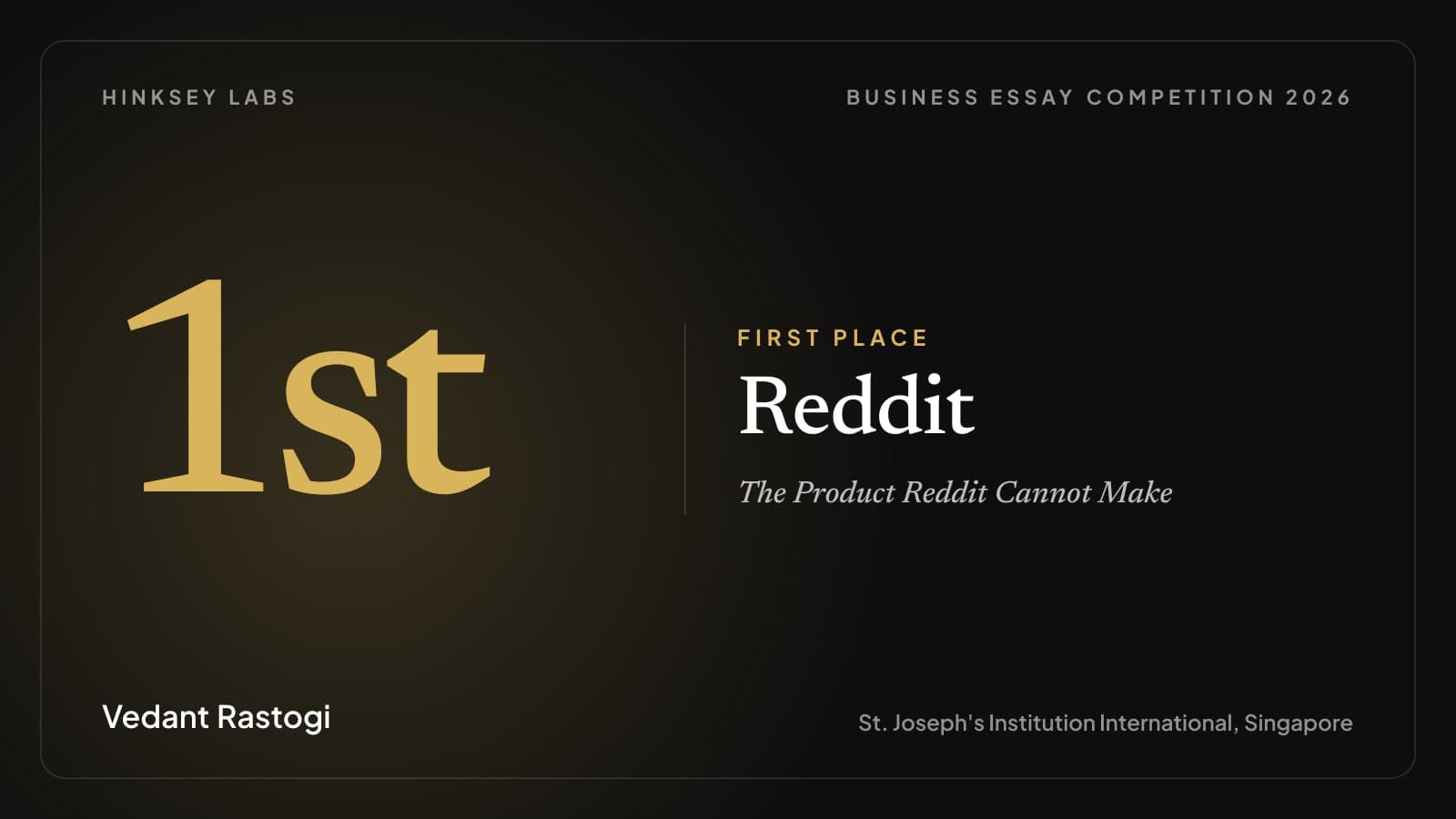
Hinksey's first-place essay, The Product Reddit Cannot Make, by Vedant Rastogi, investigates Reddit's AI data licensing business. AI was by far the most popular subject in the 2026 competition, but the essay approached it differently. It distinguished between Reddit's existing archive of content and the communities that keep creating new conversations. That distinction revealed a long-term dependency: Reddit can sell its data, but it relies on users and volunteer moderators to renew its value.
The essay then proposed a reinvestment model that could be tested - a three-year pilot, capped at what Reddit's own filings support, with a scorecard and comparison communities.
The lesson: don't stop at explaining what a company, government or market is doing. Ask what underlying incentive, dependency or overlooked consequence might change the interpretation.
5. Address the Strongest Counterargument
An economics essay becomes more convincing when it acknowledges where its argument might be wrong. Imagine you're answering the question: are tariffs always harmful to an economy?
You might argue that tariffs generally increase consumer prices and reduce economic efficiency. But a serious analysis should also consider whether tariffs could protect strategically important industries, address national security concerns or reduce dependence on vulnerable supply chains. You can then evaluate when those potential benefits might outweigh the costs.
This matters especially for the John Locke Institute's Global Essay Prize, whose guidance is blunt: "Essays which ignore or fail to address the strongest objections and counter-arguments are unlikely to be successful." The Norwegian Cruise Line essay shows the habit in a single line - "Hormuz does not explain all of this" - before it sets out what else held the company back.
The goal isn't to argue both sides equally. It's to show why your conclusion remains persuasive after examining the strongest alternative explanation.
6. Make Your Conclusion Specific and Defensible
A weak conclusion repeats what the essay has already said. A stronger one delivers a reasoned judgement and identifies the conditions under which it holds. For example:
- Weak: "Tariffs have both positive and negative effects on the economy."
- Stronger: "Although tariffs can temporarily support strategic industries, their wider economic benefits depend on whether domestic producers can expand efficiently without prolonged protection."
The second conclusion explains what determines the outcome. The three Hinksey winning essays do this in different ways:
- Reddit: proposes a measurable reinvestment experiment to protect the source of future data value.
- Norwegian Cruise Line: names four things to watch that would support or undermine its recovery argument, with a dated twelve-month forecast.
- Centrus Energy: ties its recommendations to the timing of supply constraints and planned domestic production, including signed supply for 2028 deliveries by mid-2027.
Each moves beyond describing a problem towards a judgement that readers can check.
7. Write for the Competition's Actual Rubric
Even a well-researched economics essay can miss the mark if it doesn't answer the assigned question or follow the submission requirements. The Hinksey Labs Business Essay Competition is scored by the Hinksey Labs team of Ivy League and Oxbridge academics on four criteria:
- Evidence & Sources: use credible, clearly cited evidence and work it into the analysis.
- Insight & Originality: develop an interpretation beyond the obvious.
- Clarity & Structure: build a focused, logical argument.
- Use of Business Concepts: apply relevant frameworks accurately.
These principles are useful across economics competitions, although each organiser has its own requirements.
How Do Economics Essay Competitions Compare?
Each competition rewards serious economic thinking, but they ask for different things. Deadlines, eligibility and entry rules for each are in our 2027 business and economics competitions calendar.
Hinksey Labs Business Essay Competition
Hinksey's 2026 competition asked students to investigate how a major change affected a company or non-profit. Entries were 1,000-1,500 words and had to cover the organisation's background, the shift, its impact and the response. They were scored on the four criteria above by the Hinksey Labs team of Ivy League and Oxbridge academics. Entry is free and open to students aged 14-18 worldwide; the top three won scholarships to a Hinksey Labs programme such as Research Scholars or Research Fundamentals, and the winning essays are published on this blog with a note from the judges.
John Locke Institute Global Essay Prize (Economics)
Students answer one set economics question and build a persuasive argument. The 2026 rules allowed up to 2,000 words and judged knowledge and understanding, use of evidence, argumentation, originality, structure, writing style and persuasive force. The full rules, timeline and categories are in our John Locke Essay Competition guide.
Royal Economic Society Young Economist of the Year
Open only to students studying in the UK. Entrants choose one of five questions on contemporary economic issues and submit either a blog of up to 1,000 words, a video or podcast of up to five minutes, or a short slide presentation; AI tools are not permitted. A shortlist of five then presents to an expert panel and takes questions, so the argument has to hold up out loud (2026 competition).
Marshall Society Essay Competition
Run by the Marshall Society, the official economics society of the University of Cambridge, this competition draws entries from around the world on questions of theory, policy, economic history and real-world issues. Its 2026 questions asked, among others, whether it is fair always to call tariffs bad and how far central banks can stabilise an economy facing external energy shocks; the society says just under 10% of essays were shortlisted.
Prompts, judging, eligibility and submission rules all differ between cycles, so always read the current official guidelines before you start an entry.
A Practical Structure for Your Economics Essay
If you're unsure how to organise your argument, start with this framework:
- Introduction: introduce the problem and state your argument.
- Economic framework: explain the concepts needed to analyse it.
- Evidence and analysis: support your argument with relevant data and reasoning.
- Counterargument: evaluate the strongest opposing explanation.
- Conclusion: deliver a clear judgement with appropriate limitations.
This isn't a universal template. Some questions need more theoretical discussion, others deeper empirical analysis, and some competitions set the sections for you - Hinksey's asks for background, shift, impact and response. What matters is that every section helps answer the question.
Final Checklist Before Submitting
Before you submit your economics essay, ask yourself:
- Have I answered the exact question?
- Is my central argument clear?
- Have I explained the economic mechanisms behind my claims?
- Does my evidence directly support my reasoning?
- Have I considered credible counterarguments?
- Does my conclusion go beyond simply summarising?
- Have I followed the competition's word limit, citation, originality and AI-use rules?
For further inspiration, read the three 2026 Hinksey Labs winning essays - The Product Reddit Cannot Make, Haaland Hates Cruises and Centrus Energy: Winner and Casualty of America's Russian Uranium Ban - and look at how each writer handles evidence, analytical reasoning and conclusions. Each one comes with a note from the judges on what made it stand out.
The Takeaway
There's no guaranteed formula for winning an economics essay competition. But the strongest entries tend to share a few characteristics: they ask meaningful questions, make defensible arguments, apply economic theory carefully and use evidence to reach conclusions that aren't immediately obvious.
Don't aim to demonstrate how many economic concepts you know. Aim to show how well you can use them to explain something important. That's the difference between an essay that describes an economic issue and one that makes a compelling case.
If you want to take these habits further than a 1,500-word entry, Research Scholars applies them over 12 weeks: market, competitive and financial analysis of a real organisation's challenge, with an Ivy League or Oxbridge mentor and a full research paper at the end.
Ready to pick a competition? See the 2027 deadlines, eligibility and AI rules for 19 business, economics and essay competitions. Business and economics competitions 2027